“पासपोर्ट (Paas-port)” was submitted as part of Khushi’s final project for ENGL 4067: Comics and Graphic Novels—Nonfiction Comics taught by Prof. Jason S. Polley in semester 2, AY 2025-2026.
Artistic Statement:
Khushi Gurung, 2026, Memoir (Found Object)
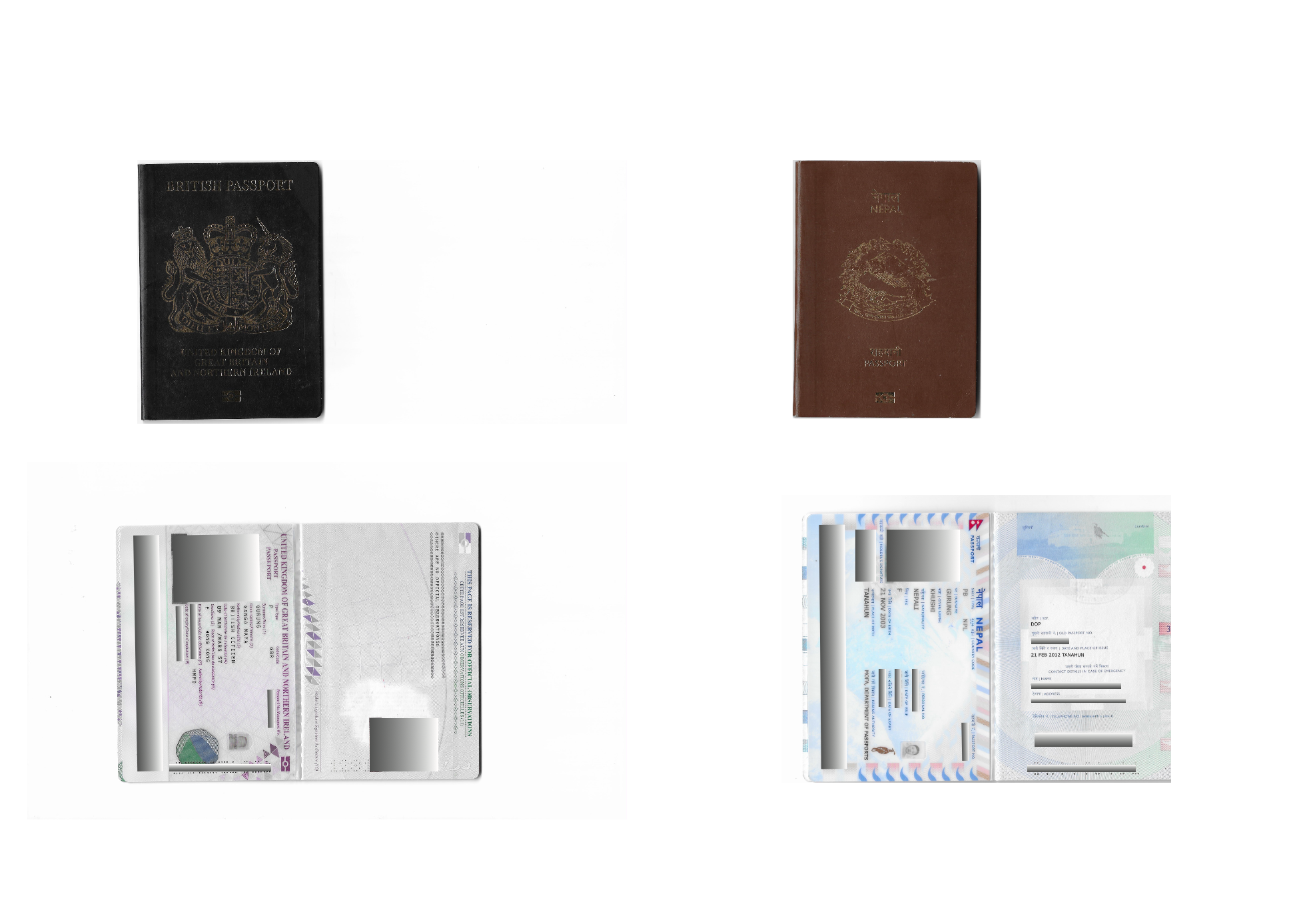
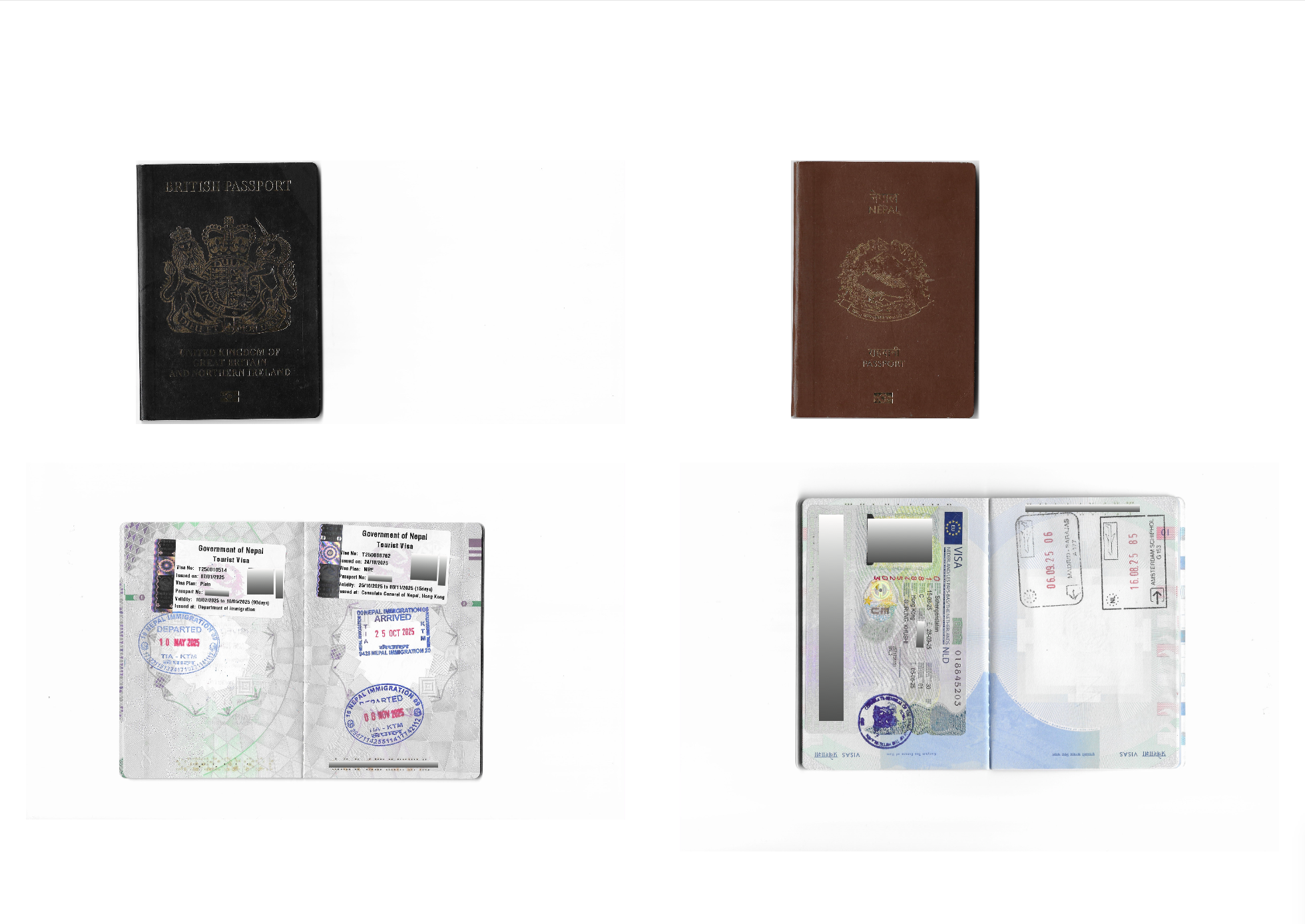
The piece titled पासपोर्ट (Paas-port) is a pair of passport documents that the artist presents as a memoir. Through this reframing, the artist invites viewers to look beyond the documents’ official function and engage with them instead as bearers of a narrative being told.
On the Work
To begin understanding the work, it is important to unpack certain details that may not be immediately clear without some familiarity with Nepal’s socio-political and historical context. At first glance, two passports are presented, issued by different countries: one from Nepal and one from Great Britain. The demographic information identifies two individuals—Khushi Gurung, aged 22, a Nepali citizen, and Ganga Maya Gurung, aged 69, a British citizen.
From this information alone, several questions arise: why are these two passports paired together? What is the relationship between these individuals? And if they are related, why do they hold different nationalities? These questions are essential to engaging with the work, and their answers begin to emerge through inference.
One of the passports belongs to the artist herself, which situates the work within a personal framework. The shared surname suggests a familial relationship, and given the age difference, it can be understood that they are granddaughter and grandmother. However, this immediately leads to a more complex question: how can two closely related individuals hold such different national identities?
To approach this, some historical context is necessary. For decades, Nepal has experienced significant migration due to limited economic opportunities. At the same time, the British Army recruited soldiers from Nepal, known as Gurkhas. These soldiers (often from specific ethnic groups, including the Gurung community) left their villages to serve abroad, and many of their families were eventually able to settle in the United Kingdom. In Nepal, such soldiers are culturally referred to as Lahure. This history created one of the few pathways through which Nepali families could obtain British citizenship, helping explain how the older figure in the work holds a British passport.
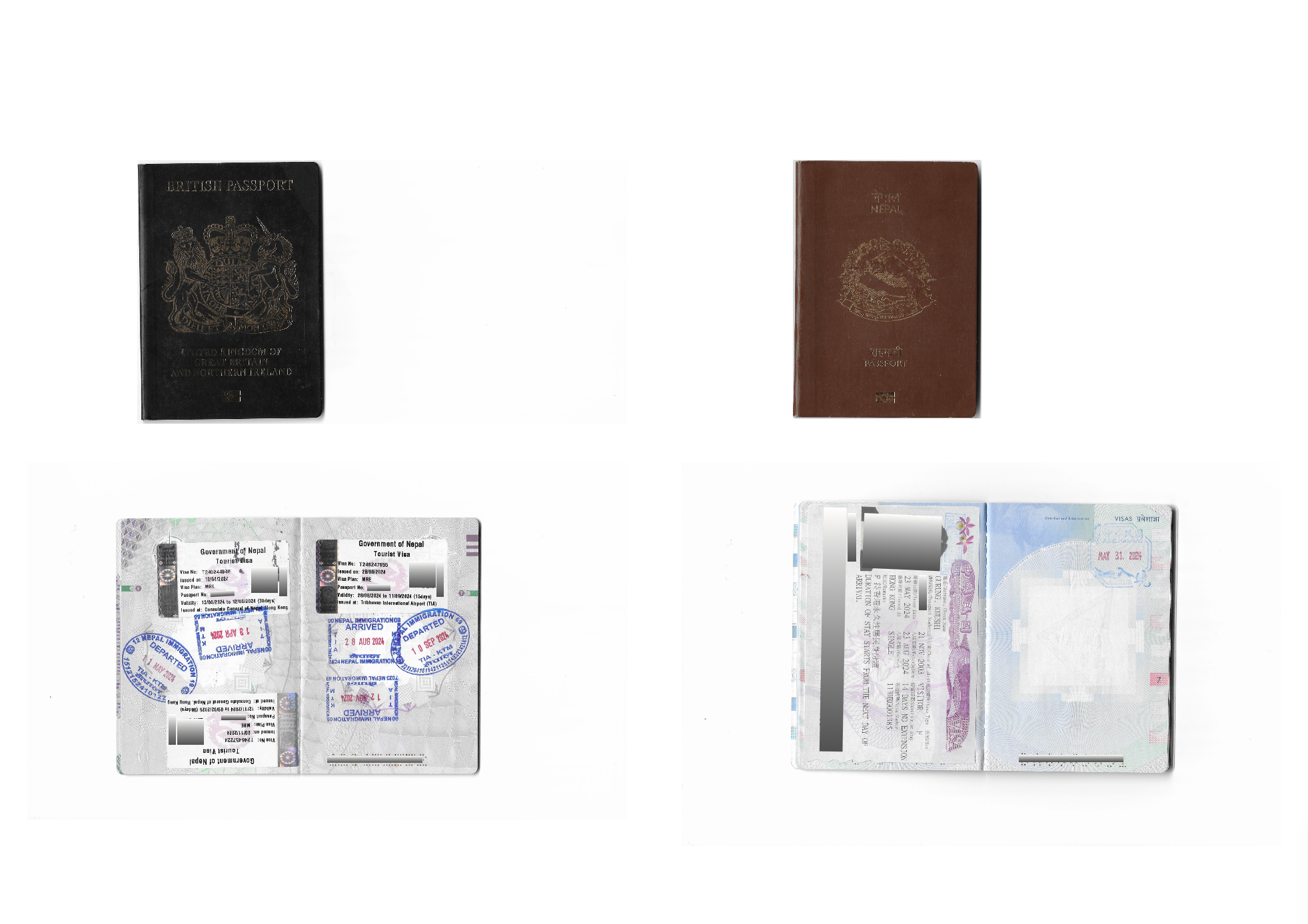
As the work unfolds, the passports reveal their travel histories. The British passport is filled with visa stamps to Nepal, documenting repeated visits of varying durations. In contrast, the Nepali passport contains visa stamps to multiple countries outside Nepal. This contrast becomes central to the work’s meaning.
The first narrative is striking. A woman of Nepali origin holds a British passport (a document that offers high global mobility) yet uses it primarily to return to Nepal. Despite her deep cultural and personal ties to the country, she must apply for visas, pay fees, and accept time limitations to enter what is, in every sense, her home. There is something both ironic and unsettling in this: the idea of having to pay and seek permission to stay in one’s own country, and only temporarily. At the same time, the repetition of these visa stamps suggests persistence, even resistance—a continuous return driven by attachment and belonging, despite bureaucratic barriers.
The second narrative presents the inverse. As a Nepali passport holder, my own experience reflects a different set of constraints. Movement outward is possible, but only through extensive bureaucratic processes; each journey requires exhausting visas, documentation, and approval. The stamps in the passport become not just records of travel, but evidence of limitation. This condition is not unique to
me; it reflects a broader reality in Nepal. Due to limited economic opportunities, many young individuals are compelled to leave the country in order to support themselves and their families, with remittances forming a significant part of the national economy.
Placing these two passports side by side reveals a stark inequality in mobility. One passport allows relatively free movement across borders, while the other demands constant negotiation through bureaucratic systems. Beyond mobility, however, the work exposes a deeper tension between legal identity and cultural belonging. Ganga Maya, despite her deep-rooted connection to Nepal, is legally treated as a foreigner in her own homeland. I, meanwhile, belong legally to Nepal but face barriers when attempting to access the wider world.
This creates a paradox central to the diaspora experience. One generation gains mobility but becomes distanced from uncomplicated belonging, while the next retains cultural and national identity but is constrained by it. In this sense, one passport opens doors but complicates the idea of home, while the other preserves home but limits access to the world. It is within this tension that Nepal’s contemporary reality becomes most visible.
When viewed together, these passports construct a dialogue not only about two individuals, but about Nepal itself—its history of migration, its economic conditions, and its ongoing dialogue with identity and belonging. There is both a deep attachment to the country and a recognition that leaving it is often necessary for survival.
By transforming these passports into a memoir, the work challenges the authority of official documentation. A passport is typically understood as an objective record of identity and movement, yet here it becomes a narrative device. The documents are reclaimed from their bureaucratic function and used to tell a story that is both deeply personal and politically charged.
For me, these two passports encapsulate the socio-cultural, economic, and historical realities of Nepal with a clarity that feels immediate. Within the Nepali community, the work is often understood instinctively, while outside of that context it requires explanation. In this way, it operates as both a personal document and a cultural text—one that does not rely on an external, Eurocentric framework to be meaningful, but instead speaks from within its own lived context.
Bio of the Artist:
Khushi Gurung is a final-year student studying BA Visual Arts and a visual artist based in Hong Kong. She works conceptually across installations involving experimental film and kinetic sculptures, as well as physical media such as found objects and zines.